
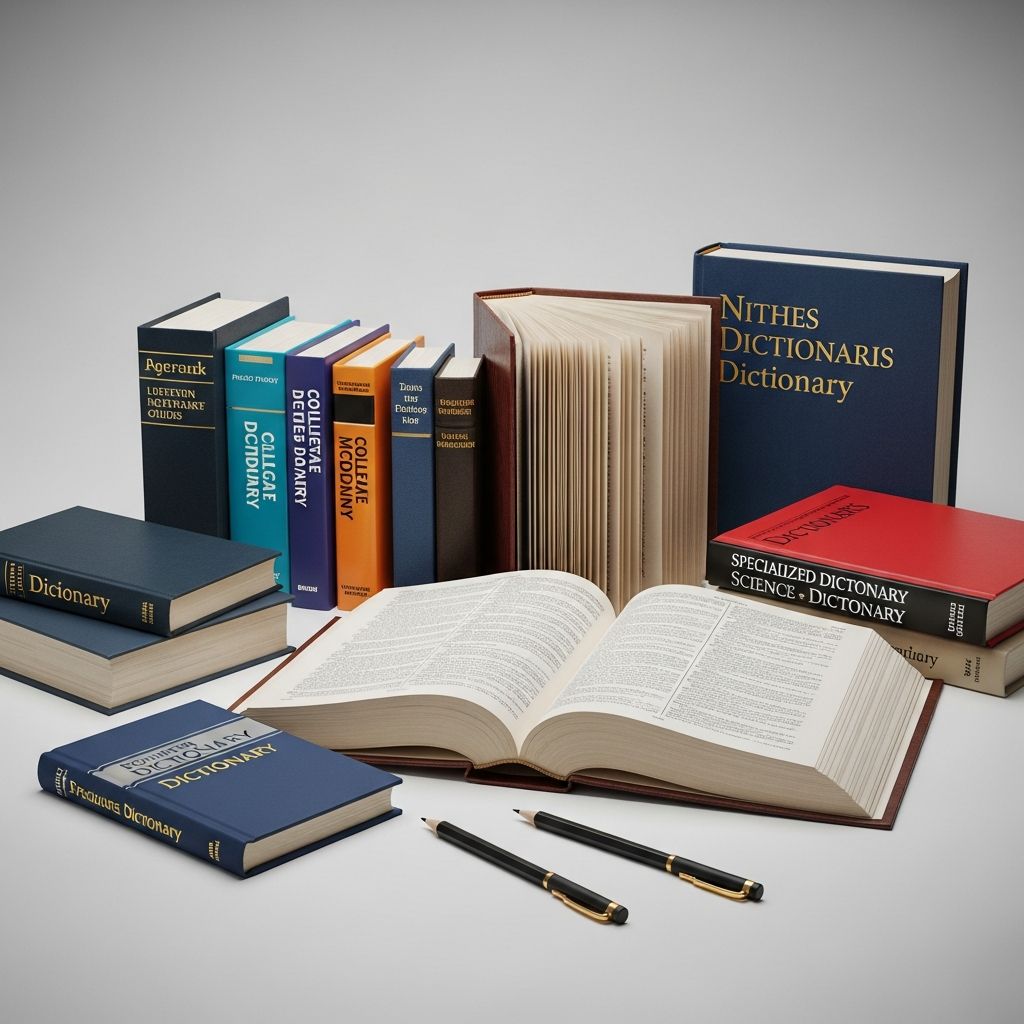
Dictionaries serve as foundational tools for anyone engaging with language, providing structured access to word meanings, pronunciations, and usage details. They bridge the gap between spoken and written forms of communication, enabling precise expression and comprehension across diverse contexts.
The Core Purpose and Definition of a Dictionary
At its heart, a dictionary is a systematic collection of words from a specific language or languages, typically organized alphabetically to facilitate quick lookup. This arrangement reflects the need for efficiency in referencing linguistic data, distinguishing dictionaries from other reference materials like encyclopedias, which focus on concepts rather than terms themselves.
Unlike glossaries that offer brief lists for niche contexts, comprehensive dictionaries aim to capture a substantial portion of a language’s lexicon. They include not just definitions but also insights into how words evolve, their grammatical roles, and real-world applications. For instance, entries often detail multiple senses of a word, reflecting its semantic range over time.
Historical Evolution of Dictionaries
The concept of compiling word lists dates back millennia, with early examples in ancient civilizations. Sumerian cuneiform tablets from around 2300 BCE represent some of the first known lexical lists, primarily for bilingual translation between Sumerian and Akkadian. These primitive dictionaries laid the groundwork for modern lexicography.
In the Western tradition, the Latin dictio, meaning ‘a saying’ or ‘expression,’ evolved into dictionarius, denoting a word collection. By the 7th century, glossaries in Latin and Old English appeared, evolving into more structured works like Samuel Johnson’s 1755 A Dictionary of the English Language, which set standards for comprehensive coverage and authoritative definitions.
The 19th century saw monumental projects like the Oxford English Dictionary (OED), initiated in 1857 and first published in full in 1928. The OED’s historical approach tracks word usage from earliest attestations, incorporating millions of quotations to illustrate evolution. This scholarly rigor transformed dictionaries into dynamic records of linguistic history.
Key Features Found in Dictionary Entries
Modern dictionaries pack rich information into concise entries. Pronunciation guides use phonetic symbols, such as the International Phonetic Alphabet (IPA), to indicate sounds. For English, Merriam-Webster employs a respelling system for accessibility.
Etymologies trace origins, revealing connections like ‘dictionary’ from Latin roots meaning ‘word collection.’ Grammatical information specifies parts of speech, inflections, and syntactic behaviors. Definitions are ordered by frequency or historical development, often with usage labels like ‘informal’ or ‘archaic.’
Illustrative examples and synonyms/antonyms enhance understanding. Some entries include field labels for technical terms, ensuring context-specific accuracy. Visual aids like diagrams appear in specialized dictionaries for terms like anatomical or mechanical concepts.
| Element | Description | Example |
|---|---|---|
| Pronunciation | Phonetic transcription | /ˈdɪkʃənəri/ [dictionary] |
| Part of Speech | Grammatical category | noun |
| Definition | Primary meaning | A reference book listing words alphabetically |
| Etymology | Word origin | From Latin dictionarius |
| Usage Example | Contextual sentence | “Consult the dictionary for the word’s meaning.” |
Categories of Dictionaries by Scope and Function
Dictionaries vary widely in scope. General dictionaries cover broad language use, suitable for everyday needs. Specialized dictionaries target domains like medicine, law, or technology, defining jargon with field-specific depth.
- Monolingual dictionaries: Define words within the same language, ideal for native speakers refining usage.
- Bilingual dictionaries: Translate between two languages, essential for learners and translators.
- Multilingual dictionaries: Handle three or more languages, common in international business.
- Thesaurus: Focuses on synonyms and antonyms rather than definitions.
- Learner’s dictionaries: Simplified for non-native speakers, with clear examples and common phrases.
Unabridged dictionaries like the OED offer exhaustive coverage, while abridged versions prioritize common words for portability. Desk dictionaries balance comprehensiveness with convenience.
The Craft of Lexicography
Lexicography, the art and science of dictionary-making, involves rigorous methodology. Lexicographers analyze corpora—vast text databases—to observe real usage, ensuring definitions reflect contemporary language.
The process begins with word selection, prioritizing frequency and novelty. Entries are drafted with evidence from citations, debated for accuracy, and revised iteratively. Digital tools now enable real-time updates, capturing neologisms like ‘selfie’ or ‘podcast’ swiftly.
Lexicology, a related linguistic field, studies lexicon structure theoretically, informing lexicographical practice. This interplay ensures dictionaries remain relevant amid language change.
Dictionaries in the Digital Era
Print dictionaries persist, but digital formats dominate. Online platforms like Merriam-Webster and Oxford offer searchable interfaces, audio pronunciations, and usage graphs tracking word popularity over time.
Apps integrate with devices for instant access, while corpus-based tools like Google Ngram Viewer visualize historical trends. Digital dictionaries enable hyperlinking related terms and multimedia, enhancing interactivity.
Challenges include information overload and authority maintenance. Crowdsourced efforts like Wiktionary supplement but lack the editorial oversight of professional works.
Educational and Practical Value of Dictionaries
In education, dictionaries build vocabulary, teach spelling, and foster critical reading. They clarify ambiguities, as words often carry multiple meanings context-dependent.
Writers rely on them for precision, avoiding malapropisms. Translators use bilingual editions to navigate cultural nuances. Even programmers repurpose the term for data structures mapping keys to values, underscoring its conceptual versatility.
Daily, dictionaries debunk myths, like prescriptive vs. descriptive approaches—modern ones describe usage rather than dictate it.
Comparing Dictionary Types
| Aspect | Monolingual | Bilingual |
|---|---|---|
| Primary Use | Define in same language | Translate between languages |
| Audience | Native/advanced learners | Language students/translators |
| Features | Etymology, synonyms | Equivalents, idioms |
| Examples | OED, Merriam-Webster | Oxford-Harrap, Collins |
Frequently Asked Questions (FAQs)
What distinguishes a dictionary from an encyclopedia?
A dictionary explains words and their linguistic properties, while an encyclopedia details topics, people, and things.
Are online dictionaries as reliable as print versions?
Reputable online dictionaries from established publishers maintain high standards, often updating faster than print.
How do dictionaries handle new words?
Lexicographers monitor usage in media and speech, adding terms once they reach sufficient frequency and stability.
What is the role of pronunciation guides?
They standardize spoken forms using symbols, helping users articulate words correctly across dialects.
Can children use dictionaries effectively?
Yes, illustrated learner’s dictionaries teach spelling, meanings, and usage through engaging formats.
Future Directions for Dictionaries
AI integration promises smarter searches, predicting queries and personalizing content. Voice-activated dictionaries could redefine accessibility. As languages globalize, multilingual resources will expand, incorporating endangered tongues for preservation.
Ultimately, dictionaries endure as guardians of linguistic heritage, adapting to technological shifts while preserving the essence of human expression.
References
- Dictionary – Wikipedia — Wikimedia Foundation. 2023-10-15. https://en.wikipedia.org/wiki/Dictionary
- DICTIONARY Definition & Meaning – Merriam-Webster — Merriam-Webster. 2024-01-20. https://www.merriam-webster.com/dictionary/dictionary
- Dictionary | Definition, History, Types, & Facts | Britannica — Encyclopædia Britannica. 2023-11-05. https://www.britannica.com/topic/dictionary
- What Is A Dictionary? – The Language Library – YouTube — YouTube. 2022-05-12. https://www.youtube.com/watch?v=jo7davMC52k
- Dictionary Skills for Kids – YouTube — Twinkl Teaching Resources. 2023-03-18. https://www.youtube.com/watch?v=Lt2nWcOek8w
- What is a dictionary? (How To) – Treehouse — Treehouse. 2024-02-10. https://teamtreehouse.com/library/introducing-dictionaries/what-is-a-dictionary
- But What is a Dictionary For? — ScholarWorks@GVSU (James C. Stalker). 1985-01-01. https://scholarworks.gvsu.edu/cgi/viewcontent.cgi?article=1756&context=lajm

Medha Deb is an editor with a master's degree in Applied Linguistics from the University of Hyderabad. She believes that her qualification has helped her develop a deep understanding of language and its application in various contexts. Medha specializes in the areas of beauty, health, sports, and wellness and is committed to ensuring that the content on the website is…