
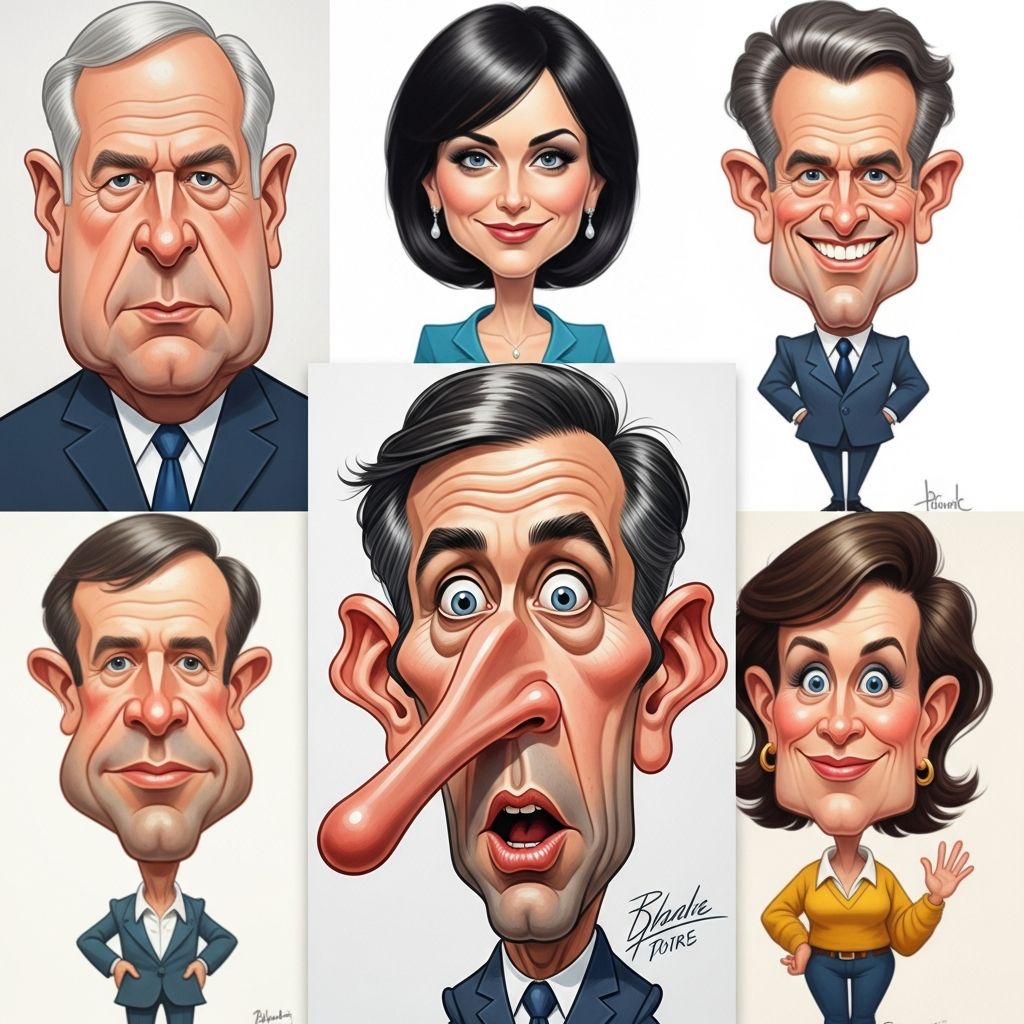
Caricature stands as a powerful form of visual and literary expression that amplifies distinctive traits to provoke laughter, critique, or reflection. By distorting features in a recognizable yet hyperbolic manner, it captures essence beyond mere likeness, serving as both entertainment and social commentary.
Defining the Essence of Caricature
At its core, caricature involves deliberate overstatement of physical, behavioral, or personality attributes to create a distorted yet identifiable portrayal. This technique, derived from the Italian caricare meaning ‘to load,’ loads emphasis on key characteristics like a prominent nose or quirky mannerism, transforming observation into art. Unlike straightforward portraits, caricatures prioritize impact over realism, often blending humor with sharp insight.
Rendered through sketches, drawings, or descriptive prose, caricatures can compliment, mock, or satirize their subjects. They draw from natural traits (e.g., large ears), acquired marks (e.g., scars), and vanities (e.g., hairstyles), ensuring the result remains true to the original while heightening effect. Dictionaries reinforce this: Merriam-Webster describes it as ‘ludicrous distortion of parts or characteristics,’ applicable in visuals or text.
Historical Roots and Evolution
Caricature emerged in Italy around 1600 with artists like Annibale Carracci, who distorted forms for mockery. By the 18th century, it flourished in Britain through William Hogarth’s satirical works, such as his 1748 painting featuring exaggerated French figures, marking the term’s English debut that year. Publications like the Caricature Magazine (1807-1819) popularized it for political jabs.
The 18th and 19th centuries saw masters like James Gillray and Thomas Rowlandson wielding caricature as a weapon against authority, exaggerating politicians’ flaws amid events like the Napoleonic Wars. This era solidified its role in print media, evolving from personal portraits to broad social critiques. Britannica notes its shift toward cartoons for editorial opinion in newspapers.
- Key Milestones:
- 1600s: Italian origins with Carracci family.
- 1748: English adoption via Hogarth.
- 1800s: Peak in political satire by Gillray and Rowlandson.
- 20th Century: Integration into magazines and animation.
Techniques Behind Effective Caricatures
Crafting a caricature demands keen observation and balance. Artists select 2-3 dominant features—say, a jutting chin or bushy brows—and amplify them proportionally while simplifying the rest for clarity. Likeness remains paramount; without recognizability, it fails as caricature.
Exaggeration extends beyond physique to gestures and expressions, capturing ‘acquired characteristics’ like slouched posture from desk work. Styles vary: some favor grotesque distortion for satire, others gentle mockery for fun. ProWritingAid highlights its literary parallel, overemphasizing traits for humorous or grotesque effect.
| Element | Description | Example |
|---|---|---|
| Likeness | Retains core identity | Protruding ears match subject’s real ones |
| Exaggeration | Amplifies select traits | Ears tripled in size |
| Simplification | Reduces details | Background omitted |
| Judgment | Artistic choice for impact | Humorous vs. savage tone |
Tools range from pencil sketches to digital software, but the principle endures: distortion with purpose.
Caricature in Visual Arts and Street Performance
Street artists epitomize caricature’s accessibility, rapidly sketching tourists with ballooned heads or spindly limbs for instant amusement. These live portraits balance speed and skill, often evoking joy through playful distortion. In galleries, caricatures critique via subtlety, like substituting animal features for human vices.
Modern applications include event entertainment and personalized gifts, where artists like those at Caricatures by Kathy emphasize fun over ugliness, exaggerating ‘everything’ from hair to earrings for personality. This democratizes the form, making it a staple at weddings and fairs.
Literary Caricature: Words as Weapons
Beyond visuals, caricature thrives in literature through hyperbolic character sketches. Authors exaggerate quirks—greed, vanity, folly—for satire, as in Dickens’ over-the-top villains or Swift’s Gulliver’s Travels. It simplifies behaviors to spotlight human flaws, often politically.
Accidental caricatures emerge as stereotypes, revealing biases, while intentional ones provoke thought or laughter. StudioBinder defines it as exaggerated description for critique, bridging art and prose.
Satire and Political Power
Caricature’s sharpest edge lies in politics, where it ridicules leaders by magnifying weaknesses—Napoleon as a diminutive tyrant, modern presidents with comically oversized egos. Gillray’s savage works mocked monarchy, proving its corrective force against inertia.
Today, editorial cartoons in outlets like The New Yorker wield it for commentary, blending entertainment with bite. Tate notes its mocking intent via distorted forms.
Modern Applications and Digital Frontier
Digital tools have revolutionized caricature, enabling apps for self-portraits and AI-assisted distortions. Social media amplifies viral caricatures, from celebrity roasts to protest art. Animation integrates it seamlessly, as in The Simpsons‘ exaggerated archetypes.
Yet, ethical lines blur: when does satire become offense? Boundaries shift culturally, demanding sensitivity.
Mastering Caricature: Tips for Aspiring Artists
Begin with observation: study subjects for 5-10 minutes. Sketch lightly, identify 3 traits, exaggerate gradually—20-50% first, then refine. Practice daily on photos or mirrors. Resources like YouTube tutorials break down strokes.
- Observe natural, acquired, and vanity traits.
- Maintain 70% likeness, 30% distortion.
- Test recognizability with others.
- Experiment with tones: fun vs. critical.
Frequently Asked Questions (FAQs)
What distinguishes caricature from a cartoon?
Caricatures focus on individual likeness via exaggeration, while cartoons often depict general scenes or ideas for broader commentary.
Can caricatures be complimentary?
Yes, they highlight endearing traits playfully, avoiding ridicule for celebratory effect.
Is caricature only visual?
No, it appears in literature through descriptive exaggeration for satirical purposes.
How has technology changed caricature?
Digital apps and AI speed creation and enable sharing, expanding reach beyond traditional sketches.
What’s the risk of poor caricature?
Unintentional ones foster stereotypes, undermining credibility and revealing biases.
Caricature’s Enduring Cultural Impact
From Renaissance sketches to memes, caricature endures by distilling complexity into compelling visuals or words. It challenges viewers to see beyond surfaces, fostering discourse on power, identity, and folly. As society evolves, so does this art, remaining a mirror—distorted yet truthful.
References
- Caricature: Definition, Meaning & Examples in Literature — ProWritingAid. 2023. https://prowritingaid.com/caricature
- Caricature – Wikipedia — Wikipedia Contributors. 2023-10-01. https://en.wikipedia.org/wiki/Caricature
- What is Caricature — The Art of Exaggeration Explained — StudioBinder. 2023. https://www.studiobinder.com/blog/what-is-caricature-definition/
- What is Caricature? Caricature Definition, Meaning & Explanation — Caricatures by Kathy. 2023. https://www.caricaturesbykathy.com/post/caricature-definition
- Caricature and cartoon | Definition, History, & Facts — Encyclopædia Britannica. 2023-11-15. https://www.britannica.com/art/caricature-and-cartoon
- CARICATURE Definition & Meaning — Merriam-Webster. 2023. https://www.merriam-webster.com/dictionary/caricature
- Caricature — Tate. 2023. https://www.tate.org.uk/art/art-terms/c/caricature

- Integrated M.A. in Applied Linguistics, University of Hyderabad
- 5+ years in editorial, instructional, SEO, and research-based writing
Sneha is a relationships and lifestyle writer with a strong foundation in applied linguistics and certified training in relationship coaching. She brings over five years of writing experience to theskillvault, crafting thoughtful, research-driven content that empowers readers to build healthier relationships, boost emotional well-being, and embrace holistic living. Her writing and insights reflect the belief that beauty, happiness, and wellness…