
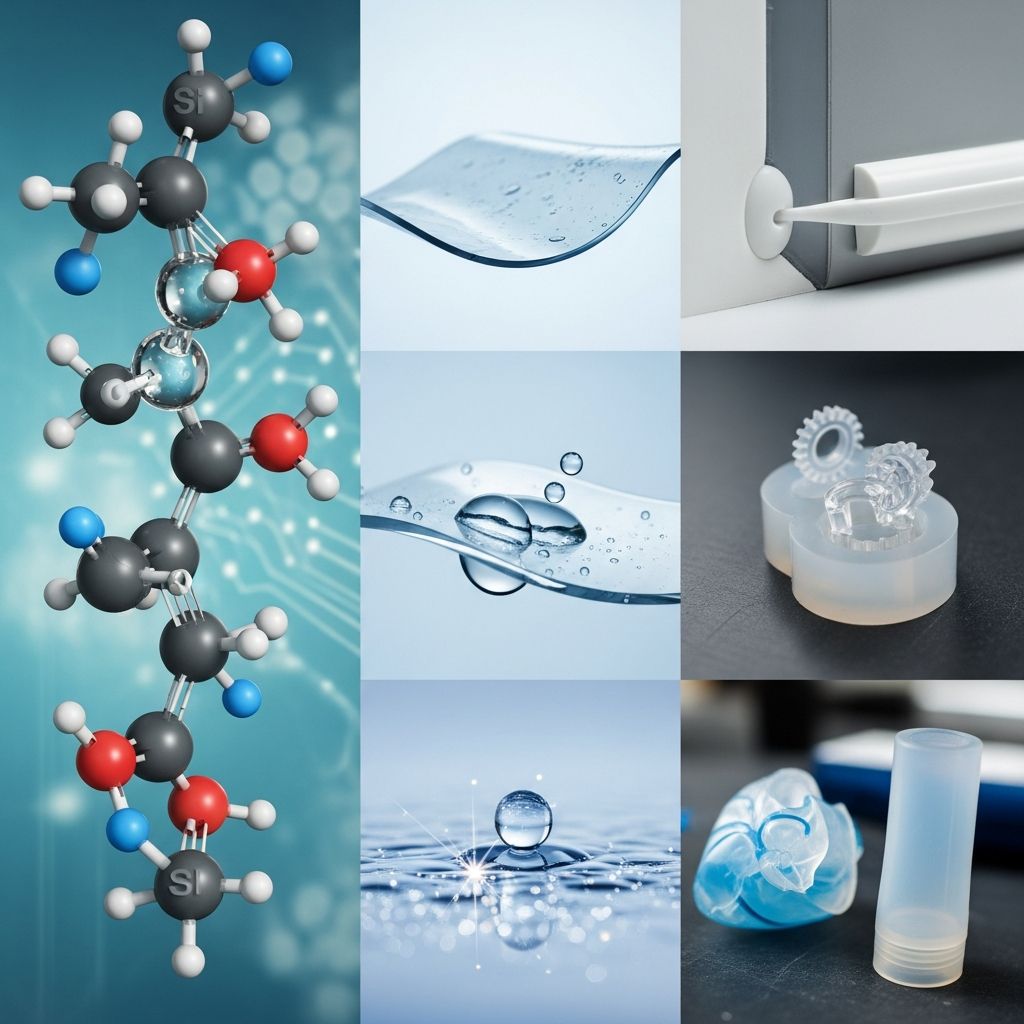
Silicone is a synthetic polymer family renowned for its exceptional versatility, derived from silicon-oxygen backbones combined with organic groups, distinguishing it from traditional carbon-based polymers. Its unique structure enables outstanding thermal stability, flexibility, and chemical resistance, making it indispensable in industries from healthcare to aerospace.
The Molecular Foundation of Silicone
At its core, silicone consists of repeating siloxane units (-Si-O-Si-), where silicon atoms are bonded to oxygen in a chain, with organic substituents like methyl or phenyl groups attached to the silicon. This inorganic backbone provides superior heat resistance compared to organic polymers, while the organic side groups impart flexibility and hydrophobicity.
Unlike elemental silicon, a brittle metalloid abundant in sand and quartz, silicone polymers are produced through hydrolysis of chlorosilanes followed by polymerization. Common variants include polydimethylsiloxane (PDMS), the most prevalent form, offering low toxicity and biocompatibility ideal for consumer products.
- Key structural features: Si-O bonds confer thermal stability up to 250°C; organic groups enable customization for specific needs.
- Production process: Involves dimethyldichlorosilane reacted with water, yielding cyclic or linear siloxanes that polymerize into viscous fluids, elastomers, or resins.
This hybrid nature—part inorganic, part organic—underpins silicone’s ability to withstand extreme conditions while remaining flexible and durable.
Exceptional Physical and Chemical Properties
Silicone exhibits a rare combination of properties that outperform many materials. It maintains elasticity from -100°C to 250°C, resisting thermal degradation where rubbers harden or melt. Its low glass transition temperature ensures flexibility in cryogenic applications, while high thermal stability suits high-heat environments like engines.
Chemically inert, silicone repels water, oils, and most solvents, with excellent UV and ozone resistance for outdoor longevity. Electrically insulating yet formable as conductive variants, it protects circuits from moisture and shock. High gas permeability benefits medical uses requiring oxygen transmission, though it limits vacuum sealing.
| Property | Description | Typical Range |
|---|---|---|
| Thermal Stability | Withstands extreme temperatures without degrading | -100°C to 250°C |
| Flexibility | Elastomeric behavior across wide temp range | Shore A 20-80 hardness |
| Chemical Resistance | Inert to acids, bases, oxidation | Excellent UV/ozone resistance |
| Electrical Insulation | High dielectric strength | Dielectric constant 2.9-3.1 |
| Biocompatibility | Non-toxic, FDA-approved grades | Suitable for implants |
These attributes stem from the Si-O bond’s strength (460 kJ/mol vs. 360 kJ/mol for C-C), low intermolecular forces, and helical chain conformation.
Transformative Roles in Healthcare and Medicine
Silicone’s biocompatibility and flexibility revolutionized medical devices. FDA-approved formulations enable long-term implants like breast prostheses, stents, and pacemakers, minimizing rejection risks. Respiratory masks, feeding tubes, and catheters benefit from its softness, gas permeability, and sterilizability.
In dentistry, silicone molds capture precise impressions for prosthetics. Hydrogel-infused silicones form soft contact lenses, while gels cushion wound dressings and bandages. During the COVID-19 pandemic, silicone’s role in ventilator tubing and masks highlighted its reliability under pressure.
- Prosthetics and implants: Tensile strength and tear resistance ensure durability inside the body.
- Disposable devices: Non-stick surfaces prevent tissue adhesion; easy sterilization supports single-use applications.
Engineering Marvels: Automotive and Aerospace Applications
In automotive engineering, silicone gaskets, hoses, and seals endure engine heat (up to 250°C) and oil exposure, extending component life. Spark plug boots and turbocharger hoses leverage its dielectric properties and vibration damping.
Aerospace demands push silicone further: protective coatings, engine seals, and electrical insulators withstand hypersonic speeds and cryogenic fuels. Its lightweight nature reduces aircraft weight, while flame-retardant grades meet stringent safety standards.
Silicone adhesives bond dissimilar materials in composite structures, vital for modern jets and rockets.
Building and Infrastructure: Durability Against Elements
Construction relies on silicone sealants for weatherproofing windows, facades, and roofs, maintaining airtight bonds through freeze-thaw cycles. Structural glazing uses high-strength silicones to suspend glass curtain walls, enabling sleek skyscrapers.
Coatings on bridges and concrete protect against corrosion, UV degradation, and abrasion, cutting maintenance costs. Thermal insulation properties enhance energy efficiency in HVAC systems and insulated glass units.
Electronics and Energy: Insulation and Protection
Silicone potting compounds encase circuit boards, shielding from dust, moisture, and thermal shock. In solar panels, transparent encapsulants boost efficiency by 5-10% via optical clarity and UV stability, prolonging panel life to 25+ years.
High-voltage insulators prevent arcing in power lines, while flexible coatings on LEDs dissipate heat. Conductive silicones enable EMI shielding in communications infrastructure.
Consumer Products: Everyday Innovation
Kitchen silicone bakeware withstands oven temps without leaching toxins, releasing food effortlessly due to low surface energy. Swim goggles and diving masks offer watertight, hypoallergenic seals with optical clarity.
Cosmetics incorporate silicones for smooth application, moisture retention, and matte finishes. Baby bottle nipples and pacifiers prioritize safety and durability.
Environmental Impact and Sustainability
Silicone’s longevity reduces replacement frequency, conserving resources. Recyclable via specialized processes, it avoids microplastics common in petroleum plastics. Energy-efficient applications like solar encapsulants lower carbon footprints.
Biodegradation is slow due to inertness, but incineration yields non-toxic silica ash. Lifecycle assessments show lower environmental impact than alternatives in many uses.
Frequently Asked Questions (FAQs)
Is silicone safe for food contact and medical use?
Yes, many silicones are FDA-approved for food contact and implants due to low toxicity and chemical inertness.
How does silicone differ from silicon?
Silicon is a chemical element (Si); silicone is a polymer with Si-O backbones and organic groups.
Can silicone withstand high temperatures?
Standard grades handle up to 250°C continuously; specialty versions exceed 300°C.
Is silicone biodegradable?
It degrades very slowly in nature but is recyclable and incinerable without harmful emissions.
What makes silicone flexible at low temperatures?
Weak intermolecular forces and low glass transition temperature (-120°C for PDMS) prevent stiffening.
References
- 8 Uses of Silicone and Benefits — Xometry. 2023. https://www.xometry.com/resources/materials/uses-of-silicone/
- What is Silicone Rubber? Properties, Applications, & Uses — Lake Erie Rubber. 2023. https://lakeerierubber.com/what-is-silicone-rubber-properties-applications-uses/
- Silicone — Wikipedia (sourced from Ullmann’s Encyclopedia). 2023-10-01. https://en.wikipedia.org/wiki/Silicone
- An Introduction to Silicone — Silicone Engineering. 2023. https://silicone.co.uk/news/an-introduction-to-silicone/
- Silicones in Everyday Life — American Chemistry Council. 2023. https://www.americanchemistry.com/industry-groups/silicones-environmental-health-and-safety-center-sehsc/silicones-in-everyday-life

Medha Deb is an editor with a master's degree in Applied Linguistics from the University of Hyderabad. She believes that her qualification has helped her develop a deep understanding of language and its application in various contexts. Medha specializes in the areas of beauty, health, sports, and wellness and is committed to ensuring that the content on the website is…