
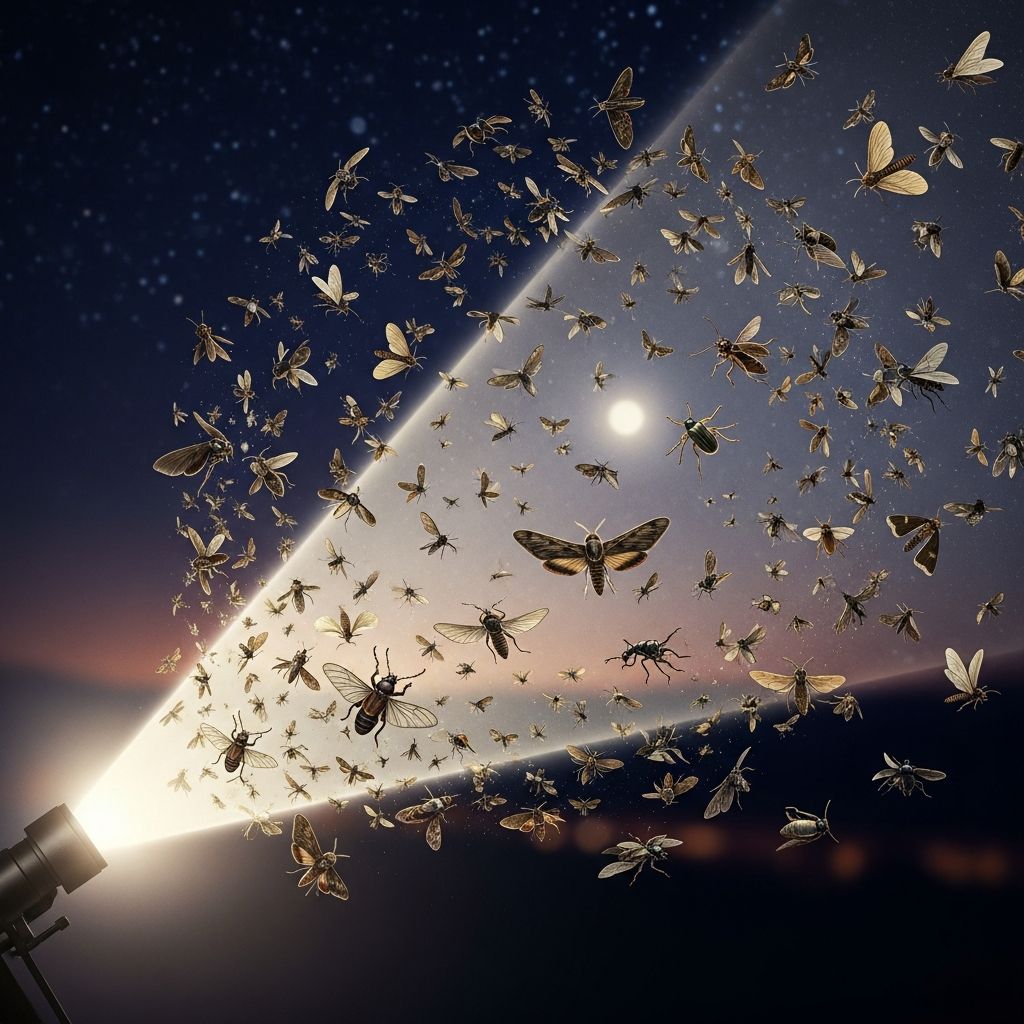
Every summer evening, porch lights and street lamps transform into buzzing hubs of insect activity. Moths spiral endlessly, flies dart erratically, and beetles collide with glowing bulbs. This captivating yet frustrating phenomenon has puzzled scientists for decades. Far from a simple attraction, recent research uncovers that insects aren’t drawn to light itself but suffer disorientation from it, rooted in evolutionary instincts gone awry.
The Widespread Phenomenon of Light-Seeking Bugs
Observing insects around artificial lights is a universal experience. Nocturnal flyers such as moths, mosquitoes, and lacewings dominate these gatherings. While daytime insects avoid light (negative phototaxis), many night-dwellers exhibit positive phototaxis, moving toward illumination. This behavior peaks in warmer months when insect populations surge.
Urban environments amplify the issue. Streetlights, billboards, and home fixtures create ‘light traps’ that disrupt natural patterns. Ecologists note declining insect populations partly blame artificial lighting, as it exhausts flyers and exposes them to predators.
Evolutionary Roots: How Insects Navigate Using the Sky
Insects evolved under natural light cycles. Before human inventions, the moon, stars, and sun served as celestial compasses. Many species maintain a fixed angle to these sources for straight-line flight, preventing spirals into the ground.
This celestial navigation theory posits bugs mistake nearby bulbs for distant luminaries. Attempting to orbit at a constant angle, they circle tighter and tighter, trapped in confusion. Fish and birds show similar responses, tilting toward light for orientation.
Debunking Old Myths: What Light Attraction Is Not
Popular ideas have fallen to scrutiny. Heat from incandescent bulbs? LEDs, which run cool, still lure bugs. Food signals? UV-emitting bulbs mimic flowers, but not all lights do, and nectar-feeders aren’t alone. Predator escape? Light indicates open paths, yet insects crash into sources, contradicting safety-seeking.
Blinding? High-intensity lights overwhelm vision, but dim lamps cause identical chaos, ruling this out. These myths persist in folklore, but evidence demands nuance.
The Breakthrough Discovery: Dorsal Light Response
A 2024 study in Nature Communications revolutionized understanding. Researchers from the UK and Sweden used high-speed cameras on 500+ insects around various lights. They revealed the dorsal light response (DLR): an innate reflex where flyers tilt their backs toward the brightest light to gauge ‘up’ from ‘down’.
Normally, DLR aligns with the sky’s glow. Artificial lights from below or sides scramble this, causing rolls, loops, and crashes. Insects don’t seek light; their survival instinct malfunctions, evaluating every glow as the horizon. Overhead lights fare better, directing bugs away rather than into spirals.
| Light Direction | Observed Behavior | Severity |
|---|---|---|
| From Below (Upward) | Inverted flight, ground spirals | High |
| Horizontal (Side) | Tight orbiting, disorientation | Medium |
| From Above (Downward) | Repulsion, less trapping | Low |
Types of Insects and Their Light Reactions
- Moths and Butterflies (Lepidoptera): Extreme circlers; DLR causes hypnotic loops.
- Flies and Mosquitoes (Diptera): Erratic darts; seek warmth and mates incidentally.
- Beetles (Coleoptera): Direct collisions; less aerial skill amplifies crashes.
- Lacewings and Caddisflies: Predator avoidance leads to light clusters.
Predatory insects arrive secondarily, feasting on trapped prey, creating food web cascades.
Ecological Consequences of Nighttime Glow
Artificial light pollution rivals climate change for insect harm. Disoriented flyers burn energy reserves, reducing reproduction. Bat and bird predation spikes near lamps. Pollinators like moths, vital for night-blooming plants, suffer most.
Global studies estimate 60% of insects are nocturnal; pervasive lighting fragments habitats. Cities glow brighter, correlating with 30% biomass drops in lit areas. Conservation calls for ‘lights out’ policies during migration.
Practical Solutions to Deter Light-Loving Pests
Minimize swarms without darkness:
- Use yellow or sodium-vapor bulbs: Less UV, invisible to many insects.
- Shield lights downward: Reduces sky glow and upward pull.
- Motion sensors: Lights on only when needed.
- UV traps: Attract and capture selectively.
- Plant repellents: Citronella, lavender near fixtures.
Outdoor fans create turbulence, blowing bugs away. Long-term, support dark-sky initiatives.
Comparing Theories: A Scientific Timeline
| Theory | Proposed Era | Status | Key Evidence |
|---|---|---|---|
| Celestial Navigation | 1970s | Partially Valid | Angle maintenance to moon |
| UV/Flower Mimicry | 1980s | Minor Role | Selective to UV bulbs |
| Escape/Heat | 1990s | Debunked | LEDs produce same effect |
| Dorsal Light Response | 2024 | Leading | High-speed video analysis |
Frequently Asked Questions (FAQs)
Do all insects go to lights?
No, only positively phototactic species like moths do. Ants and bees often avoid artificial light.
Why do bugs hit the light bulb?
DLR forces constant reorientation; close proximity causes collisions as they can’t correct trajectory.
Are LED lights better for bugs?
They produce less heat but equal disorientation; opt for amber LEDs to cut UV.
Does light pollution kill insects?
Indirectly yes—exhaustion, predation, and failed navigation lead to higher mortality.
How can I enjoy evenings bug-free?
Downward-directed yellow lights, fans, and traps work best without chemicals.
Future Research Directions
With DLR confirmed, studies now model light spectra impacts. Quantum dots in bulbs may minimize triggers. Citizen science apps track local effects, aiding policy. Understanding this aids biodiversity preservation amid urbanization.
Insects shaped our world; respecting their instincts means dimming our nights. Simple changes yield big wins for ecosystems.
References
- Why Are Bugs & Insects Attracted to Light? — Pest World for Kids (National Pest Management Association). 2023. https://www.pestworldforkids.org/pest-info/bug-articles-by-type/why-are-insects-attracted-to-light/
- Why are Bugs Attracted to Light? — DynaTrap. 2023. https://www.dynatrap.com/articles/why-are-bugs-attracted-to-light
- Why insects gather at artificial light — Nature Communications (DOI via publisher). 2024-01-10. https://www.nature.com/articles/s41467-024-44785-3

Medha Deb is an editor with a master's degree in Applied Linguistics from the University of Hyderabad. She believes that her qualification has helped her develop a deep understanding of language and its application in various contexts. Medha specializes in the areas of beauty, health, sports, and wellness and is committed to ensuring that the content on the website is…