
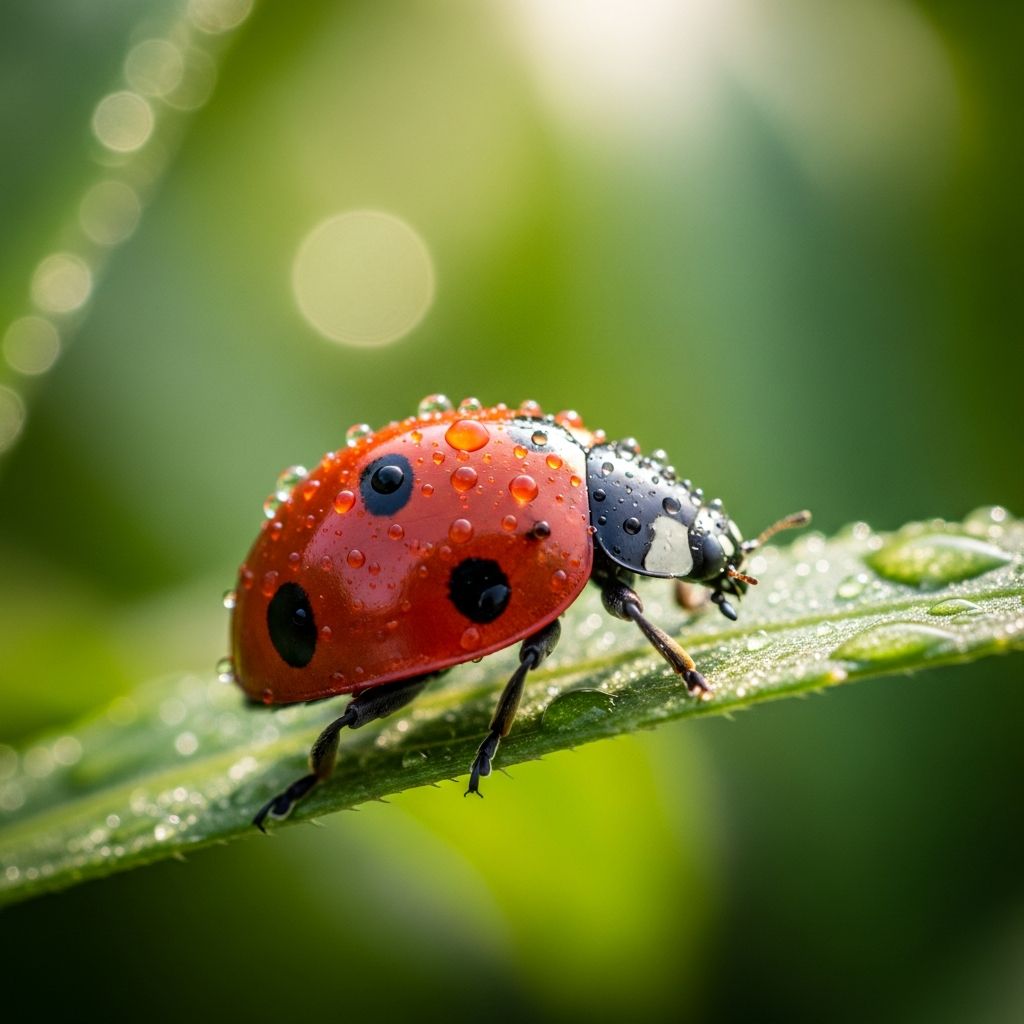
Ladybugs, those tiny red gems dotted with black spots, captivate people worldwide with their charm. Far from mere decoration, these markings serve critical survival functions in the wild. This article delves into the biology, evolution, and myths surrounding ladybug spots, revealing how these insects use visual signals to thrive.
Understanding Ladybug Biology and Diversity
Ladybugs, scientifically known as lady beetles or coccinellids, belong to a family encompassing around 5,000 species globally, with approximately 150 found in the United States. Not all exhibit the classic red body with black spots; colors range from yellow and orange to black and even white, with spot counts varying dramatically—from zero to as many as 24 on a single individual.
These beetles possess a compact, rounded body ideal for their predatory lifestyle. They feature a small head with short antennae, six nimble legs, and four wings: two soft ones for flight hidden beneath two hard, protective elytra (wing covers) that display the famous spots. This structure not only shields their flying wings but also showcases their warning patterns.
The Evolutionary Role of Spots: Aposematic Coloration Explained
The primary purpose of ladybug spots lies in aposematic coloration, a strategy where bright, contrasting colors signal to predators that the insect is toxic or unpalatable. Red or orange backgrounds paired with black spots scream “avoid me” to birds, frogs, and other hunters. Brighter hues often correlate with higher toxicity levels, as well-fed ladybugs produce more defensive chemicals from their aphid-rich diet.
Spots represent the simplest evolutionary pattern for pigment development. Emerging from fixed genetic points in the embryo, they create bold, centralized contrasts across animal kingdoms, from human freckles to leopard prints. For ladybugs, this pattern warns effectively without requiring complex designs.
- Predator Deterrence: Birds learn quickly after one bad taste, associating the pattern with foul flavors and extending the lesson to similar-looking ladybugs—a phenomenon called Müllerian mimicry.
- Toxicity Variation: Larvae build toxins from prey, influencing adult coloration intensity.
- Species Signaling: Even spotless or unusually patterned individuals benefit from the collective warning system.
Spot Patterns Across Ladybug Species
Diversity in spotting is staggering. The two-spot ladybird typically sports two black dots on red, but variants exist with black bodies and red spots. The seven-spot variety, a voracious aphid hunter devouring over 5,000 in a lifetime, exemplifies the norm but isn’t universal. Others, like the nine-spotted or 20-spotted, push variation further, sometimes lacking spots entirely or boasting extras.
| Species | Typical Color | Spot Count | Notable Trait |
|---|---|---|---|
| Two-Spot Ladybird | Red/Black | 2 (or 4-6 red on black) | Mimics toxic relatives |
| Seven-Spot Ladybird | Red | 7 | Aphid predator extraordinaire |
| Twenty-Four Spot Ladybug | Yellowish | Up to 24 | Highly variable |
| Spotless Ladybug | Various | 0 | Relies on mimicry |
Such variability underscores that spots aren’t uniform identifiers but flexible defenses honed by evolution.
Do Spots Indicate Age? Busting the Myth
A persistent folklore claims spot count reveals a ladybug’s age—one spot per year. This is entirely false. Spots form during the larval stage and remain fixed lifelong, unaffected by time. Juveniles emerge with their patterns intact, debunking the notion.
Other myths abound: more than seven spots signaling poor harvests or predicting children’s numbers. These cultural tales, while endearing, lack scientific basis. Instead, spots are immutable genetic markers present from hatching.
Symmetrical Spots and Rare Anomalies
Most ladybugs display near-perfect bilateral symmetry in spotting, enhancing their warning signal’s reliability. Deviations are rare, stemming from genetic mutations, cold-induced damage, or predator pecks scarring wing cases. These asymmetries don’t impair survival, as the overall pattern suffices for deterrence.
Ladybugs as Beneficial Garden Allies
Beyond defense, ladybugs are ecological heroes. They voraciously consume aphids, scale insects, and mites—pests ravaging crops and gardens. A single ladybug can protect plants by eliminating hundreds of these sap-suckers, earning gardeners’ favor worldwide.
In agriculture, they’re natural biocontrol agents, reducing pesticide needs. Their winter clustering in homes, though sometimes nuisance, aids overwintering survival.
Defensive Behaviors Beyond Spots
Spots pair with active defenses. When threatened, ladybugs reflex-bleed hemolymph—a yellowish, bitter fluid—from leg joints, reinforcing their warning colors. This distasteful ooze, laced with alkaloids, deters most attackers. They also play dead or drop from plants, enhancing evasion.
Human Interactions: Bites and Harmlessness
Despite biting mouthparts, ladybugs rarely nip humans, prioritizing food, mating, or shelter. Any pinch feels minor, stemming from accidental handling. Invasive Asian lady beetles may cluster indoors more, but natives remain benign.
Conservation and Threats to Ladybugs
Ladybug populations face challenges from habitat loss, pesticides, and invasive species outcompeting natives. Climate shifts alter prey availability, dulling colors in underfed individuals. Protecting gardens with native plants bolsters these vital insects.
Frequently Asked Questions (FAQs)
What is the main reason ladybugs have spots?
The spots form part of aposematic coloration, warning predators of the beetle’s toxic taste.
Can you determine a ladybug’s age by counting spots?
No, spots are set from the larval stage and do not increase with age.
Are all ladybugs red with black spots?
No, they vary in color and spot number across 5,000+ species.
Do ladybugs bite humans?
Rarely; they have mouthparts but seldom use them on people.
Why are ladybugs good for gardens?
They devour aphids and other pests, acting as natural pest control.
Conclusion: Admiring Nature’s Design
Ladybug spots exemplify evolutionary ingenuity—a simple yet powerful survival tool blending beauty with function. From deterring predators to aiding ecosystems, these patterns remind us of nature’s intricate balances.
References
- Ask The Entomologist: Why Do Ladybugs Have Spots? — Terminix. Accessed 2026. https://www.trustterminix.com/ask-the-entomologist-why-do-ladybugs-have-spots/
- Facts About Ladybirds — Discover Wildlife. Accessed 2026. https://www.discoverwildlife.com/animal-facts/insects-invertebrates/facts-about-ladybirds
- Why does the ladybug have dots? — YouTube (Transcript). Accessed 2026. https://www.youtube.com/watch?v=-nUilciv-C4
- Why Do Ladybugs Have Spots? Do Dragonflies Bite? — Vermont Public. 2020-07-03. https://www.vermontpublic.org/programs/2020-07-03/why-do-ladybugs-have-spots-do-dragonflies-bite
- Myth Buster: Can You Tell a Ladybug’s Age by Its Spots? — Reconnect with Nature. Accessed 2026. https://www.reconnectwithnature.org/news-events/the-buzz/myth-buster-can-you-tell-a-ladybug-s-age-by-its-spots

- Integrated M.A. in Applied Linguistics, University of Hyderabad
- 5+ years in editorial, instructional, SEO, and research-based writing
Sneha is a relationships and lifestyle writer with a strong foundation in applied linguistics and certified training in relationship coaching. She brings over five years of writing experience to theskillvault, crafting thoughtful, research-driven content that empowers readers to build healthier relationships, boost emotional well-being, and embrace holistic living. Her writing and insights reflect the belief that beauty, happiness, and wellness…