
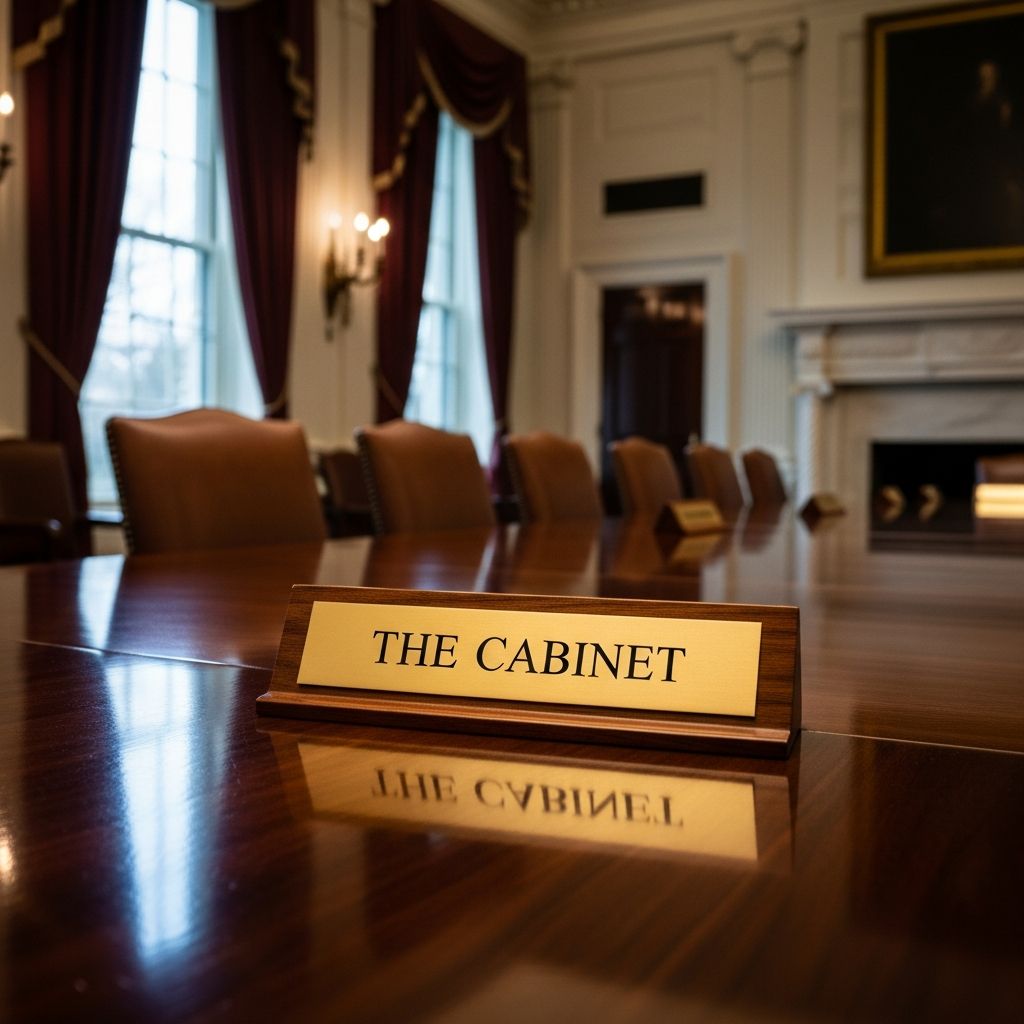
The Etymology and Historical Naming of America’s Presidential Advisory Body
The term “Cabinet” when applied to the President’s advisory council carries a fascinating historical narrative that reflects both practical governance needs and linguistic evolution in early American politics. While many citizens assume this terminology stems from constitutional law or formal governmental legislation, the reality reveals a more organic development rooted in the practical considerations of the nation’s founding leadership. The modern presidential cabinet, which serves as the collective body of department heads and key advisors to the chief executive, owes its distinctive name to a single influential figure who recognized the need for a descriptive term that would capture the informal yet essential nature of these high-level consultations.
The transformation from governmental necessity to institutionalized tradition reveals much about how American political institutions developed in their formative years. Rather than being established through constitutional mandate or legislative action, the cabinet emerged as a practical response to the demands of governing a newly formed nation. Understanding why this particular term was selected requires examining the context of late eighteenth-century American politics, the individuals involved in creating this advisory structure, and the deliberate choices made to establish precedents that would guide all subsequent administrations.
The Constitutional Gap That Led to Cabinet Creation
The framers of the United States Constitution, despite their meticulous attention to defining governmental powers and structures, made a conspicuous omission when it came to establishing a formal presidential advisory body. The Constitution itself contains no explicit provision for the creation of a cabinet, nor does it mandate the specific structure or composition of such an institution. Instead, the document provides only a general authorization, stating that the President “may require the Opinion, in writing, of the principal Officer in each of the executive Departments, upon any subject relating to the Duties of their respective Offices.” This constitutional language provided legal justification for presidential consultation but fell short of establishing any formal advisory mechanism.
This constitutional silence created a governance vacuum that became increasingly apparent as George Washington assumed the presidency and began managing the complexities of operating a functioning national government. The existing advisory mechanisms outlined in the Constitution proved inadequate for the practical demands of executive decision-making in the young republic. Washington recognized that effective governance required more comprehensive consultation and coordination among department heads than the Constitution’s sparse framework provided. His response to this institutional gap would establish a precedent that every subsequent president has followed, creating one of the most enduring features of the American executive branch.
George Washington’s Four-Person Advisory Group
When President Washington began assembling his administration in 1789, he established what would become the foundational cabinet structure. His initial cabinet consisted of four essential positions, each filling critical governmental functions. These original positions included the Secretary of State, held by Thomas Jefferson; the Secretary of the Treasury, assigned to Alexander Hamilton; the Secretary of War, entrusted to Henry Knox; and the Attorney General, under Edmund Randolph.
The establishment of these positions reflected Washington’s understanding of the nation’s immediate needs. The Secretary of State would handle foreign relations and diplomatic matters, the Treasury Secretary would manage financial affairs, the War Secretary would oversee military operations, and the Attorney General would handle legal matters. On September 11, 1789, Washington sent his first cabinet nominations to the Senate, and the body responded with swift approval, unanimously confirming Alexander Hamilton’s appointment as Secretary of the Treasury just minutes after receiving the nomination. This rapid acceptance indicated broad support for Washington’s administrative vision.
Notably, unlike the other three department heads, the Attorney General did not initially oversee an executive department, yet Washington included this position as a full cabinet member. This decision established a precedent that would allow future presidents flexibility in determining cabinet composition. Washington’s insistence on assembling a geographically diverse cabinet reflected his political acumen—he deliberately selected members representing different regions of the country to establish credibility and balance within the new administration. This strategic approach to cabinet formation would become another enduring precedent, with subsequent presidents often prioritizing geographic and ideological diversity in their selections.
The Terminology: Madison’s Influential Nomenclature
The specific term “Cabinet” applied to this presidential advisory body originated not from Washington himself but from James Madison, the prominent statesman often credited as the “Father of the Constitution.” Madison’s reference to these meetings as “the president’s cabinet” proved so apt and useful that the terminology became permanently embedded in American political discourse. Rather than emerging from a formal governmental designation or legislative decree, the name developed organically through usage and gained widespread acceptance because it effectively communicated the function and nature of these advisory gatherings.
The choice of “cabinet” as a descriptive term likely reflected the physical arrangement of these early meetings. Washington held his initial full cabinet meeting on November 26, 1791, more than two years into his presidency, after determining that the constitutional advisory mechanisms were insufficient for governing effectively. These consultations took place in Washington’s private study on the second floor of the presidential residence, creating an intimate setting reminiscent of a personal cabinet or private study. The physical location—a private room rather than a formal governmental chamber—may have influenced the terminology selection. The word “cabinet” itself, meaning a small private room or a cupboard-like space, captured this intimate advisory context while distinguishing these meetings from more formal legislative or constitutional proceedings.
Operational Evolution and Expansion of Cabinet Roles
Washington’s cabinet evolved significantly during his presidency as he navigated the challenges of governing a new nation. Initially, each secretary managed their respective department independently, focusing on issues specific to their portfolio. However, Washington demonstrated remarkable adaptability in expanding the cabinet’s role as circumstances demanded. When novel situations arose, matters of substantial consequence emerged, or national security concerns threatened, Washington would convene the entire cabinet to seek collective counsel and develop coordinated responses.
The cabinet meetings during Washington’s administration addressed critical issues that shaped the nation’s early development. Tensions between Secretary of Treasury Alexander Hamilton and Secretary of State Thomas Jefferson highlighted ideological divisions that would eventually contribute to the development of America’s first political party system. These cabinet discussions, far from being routine administrative affairs, became forums where fundamental questions about the nation’s direction were debated and decided. Washington’s willingness to convene his cabinet as needed, rather than holding regular scheduled meetings, established the precedent that presidents retained discretionary authority over cabinet consultation practices.
Modern Cabinet Structure and Expansion
The presidential cabinet has undergone substantial expansion since Washington’s original four-member body. The current presidential cabinet includes significantly more members than its eighteenth-century predecessor. What began as four essential positions has grown to accommodate the expanding scope and complexity of federal government operations. Each new cabinet position reflects the nation’s evolving needs, priorities, and the proliferation of federal departments and agencies.
| Era | Cabinet Size | Key Characteristics |
|---|---|---|
| Washington Administration (1791) | 4 members | Secretary of State, Treasury, War, Attorney General |
| 19th Century | Gradual expansion | Addition of Interior, Agriculture, Commerce departments |
| 20th-21st Century | 15-16 members | Reflects modern federal government scope |
Constitutional Status and Legal Foundation
Despite the cabinet’s central importance to American governance and its nearly two-and-a-half-century existence, it remains a institution established through custom rather than constitutional mandate or legislative enactment. This unusual status—where a crucial governmental body operates through precedent rather than formal law—demonstrates the adaptability of the American constitutional system. The cabinet’s legitimacy derives from continuous presidential usage and acceptance rather than from explicit legal authorization.
The constitutional basis for cabinet activity rests on the provision allowing presidents to seek written opinions from department heads, but no formal structure, meeting schedule, or decision-making procedures are constitutionally prescribed. This flexibility has allowed presidents to adapt the cabinet’s role to their administrative philosophy and governing style. Some presidents have utilized the full cabinet extensively, while others have relied more heavily on smaller advisory groups or sub-cabinet committees. Contemporary administrations often supplement full cabinet meetings with specialized working groups addressing specific policy domains.
Presidential Discretion in Cabinet Matters
One notable aspect of Washington’s approach that became precedential was the exclusion of certain high-ranking officials from cabinet participation. Vice President John Adams, despite his constitutional position and experience, did not participate in cabinet meetings during Washington’s administration. This exclusion established that the cabinet remains the president’s discretionary advisory body, not a mandatory institutional arrangement. Presidents retain authority to determine cabinet membership, meeting frequency, and advisory procedures according to their administrative needs and preferences.
This presidential autonomy has allowed subsequent administrations to modify cabinet structures substantially. Presidents have expanded cabinet positions, created new departments to address emerging national concerns, and adjusted the cabinet’s role in decision-making processes. The flexibility inherent in the cabinet’s non-constitutional status has facilitated its adaptation to changing governmental demands across different historical periods and political administrations.
Washington’s Enduring Cabinet Precedents
George Washington established three fundamental cabinet precedents that have guided his successors and shaped the institution’s development. First, Washington demonstrated that presidential councils required regular consultation among department heads, establishing the cabinet as a permanent feature of executive governance. Second, Washington modeled cabinet diversity by deliberately selecting members from different geographic regions, educational backgrounds, religious affiliations, and economic circumstances to represent the diverse factions of the emerging nation. This commitment to cabinet diversity reflected Washington’s broader goal of unifying the fragmented states through inclusive governance structures.
Third, Washington established the cabinet as a responsive advisory body that could be convened as needed rather than following rigid meeting schedules. This flexibility allowed presidents to utilize cabinet consultation strategically, summoning advisors when confronting novel challenges or seeking collective judgment on matters of national consequence. These three precedents—regular consultation, deliberate diversity, and responsive convocation—have remained central to how presidents assemble and utilize their cabinets.
The Cabinet’s Impact on American Governance
The cabinet institution, emerging from practical necessity and christened with a term suggesting privacy and counsel, has profoundly influenced American governmental development. Cabinet positions provide heads of major federal departments with direct access to presidential decision-making processes and authority over substantial budgets and millions of personnel. Cabinet members shape policies that affect national development, manage complex federal bureaucracies, and frequently become major political figures in their own right.
The tensions and debates that occur within cabinet settings—between department heads with different priorities, philosophical orientations, and regional interests—have historically contributed to broader political development. The Hamilton-Jefferson rivalry within Washington’s cabinet exemplified how cabinet disagreements could contribute to the development of political parties and ideological factions. Rather than viewing such tensions as governmental dysfunction, many historians recognize cabinet debates as a healthy feature of executive governance that forces presidents to consider multiple perspectives before making consequential decisions.
Common Questions About the Presidential Cabinet
Q: Why isn’t the cabinet mentioned in the Constitution?
A: The Constitution’s framers provided only general authorization for presidential consultation with department heads but did not establish a formal cabinet structure. This gap allowed presidents flexibility in creating advisory mechanisms suited to their governing approaches.
Q: Has the cabinet always had the same size?
A: No. Washington’s cabinet began with four members and has expanded substantially over two centuries as the federal government’s scope increased and new departments were created to address emerging national needs.
Q: Who originated the term “Cabinet”?
A: James Madison, often called the Father of the Constitution, coined the term when referring to Washington’s presidential advisory meetings as “the president’s cabinet.”
Q: Can a president ignore cabinet advice?
A: Yes. The cabinet serves an advisory function, and presidents retain full authority to make decisions independently of or contrary to cabinet recommendations.
Q: When was the first full cabinet meeting held?
A: George Washington convened his first full cabinet meeting on November 26, 1791, after nearly two and a half years into his presidency.
References
- Cabinet Members — George Washington’s Mount Vernon. Accessed 2026. https://www.mountvernon.org/library/digitalhistory/digital-encyclopedia/article/cabinet-members
- Current Events: The President’s Cabinet — Civics Learning Project. https://civicslearning.org/resources/current-events-the-presidents-cabinet/
- A History of Cabinet Appointments — Imperfect Union. https://imperfectunion.substack.com/p/a-history-of-cabinet-appointments
- The Cabinet: George Washington and the Creation of an American Institution — Virginia History. https://virginiahistory.org/learn/cabinet-george-washington-and-creation-american-institution
- The President’s Cabinet: Evolution, Alternatives, and Proposals for Reform — Every CRS Report. https://www.everycrsreport.com/reports/RL30673.html
- The Origin of the President’s Cabinet — White House Historical Association. https://www.whitehousehistory.org/educational-resources/the-origin-of-the-presidents-cabinet

- Integrated M.A. in Applied Linguistics, University of Hyderabad
- 5+ years in editorial, instructional, SEO, and research-based writing
Sneha is a relationships and lifestyle writer with a strong foundation in applied linguistics and certified training in relationship coaching. She brings over five years of writing experience to theskillvault, crafting thoughtful, research-driven content that empowers readers to build healthier relationships, boost emotional well-being, and embrace holistic living. Her writing and insights reflect the belief that beauty, happiness, and wellness…